Before the Seatbelt Sign: Meeting Festive Flight Anxiety with Calm
The Journey That Starts Early
For many people in the UK, the Christmas flight is not simply a matter of packing a suitcase and setting an alarm. It begins quietly, often weeks in advance: a slight tightening in the chest when the booking confirmation arrives, a restless night before the online check-in opens, a mental rehearsal of delays, turbulence or missed connections. The departure date may still be some distance away, but the body has already begun to respond as though the journey were imminent.
This is anticipatory anxiety, and it is remarkably common among otherwise confident travellers. It does not necessarily indicate a fear of aircraft themselves. More often, it reflects a nervous system that has learned to associate air travel with uncertainty, confinement and a loss of control. The festive season can intensify this, adding family expectations, winter weather and the pressure for everything to go smoothly.
At Hypnosis4U, we understand that such anxiety is not foolish or exaggerated. It is a protective response, even when it has become inconvenient. The therapeutic question is not how to argue with that response, but how to help it settle enough for the journey to feel manageable again.
How Anticipatory Flying Anxiety Shows Up
The pattern varies from person to person. Some notice a persistent low-level unease in the days before travel. Others experience more pronounced symptoms: disrupted sleep, a churning stomach, irritability, a dry mouth, or a tendency to check the weather forecast and flight status far more often than is useful.
There may also be a strong mental loop of imagined disasters. A person might picture the security queue, the boarding gate, the moment of take-off, or a difficult landing. These images can feel vivid and immediate, and the body may respond to them as if they were happening now. In this way, the mind can spend several weeks living through a flight that has not yet taken place.
Such anticipation is often worsened by avoidance. Putting off packing, refusing to discuss the trip, or telling oneself that the holiday could be cancelled may bring brief relief, but it tends to keep the anxiety in place. The mind learns that the flight is something to be feared, and the cycle continues.
What Therapeutic Hypnosis Can Offer
Therapeutic hypnosis is not a magic wand, nor does it involve losing control or being made to do anything against one's will. It is a collaborative approach that uses focused attention and gentle suggestion to help a person access a calmer, more resourceful state. For travel anxiety, it can be used to soften the automatic threat response and to rehearse new ways of meeting the journey.
A hypnotherapist might begin by helping the client describe the anxiety with care and precision: when it starts, where it is felt in the body, and what images or words accompany it. From there, the work may involve guiding the client into a relaxed state and introducing suggestions that support steadiness, perspective and a sense of choice. Some practitioners use imagery, inviting the client to mentally walk through the airport and the flight while remaining calm and grounded.
This is not about pretending that flying is effortless. It is about reducing the intensity of the fear so that it no longer dominates the weeks before departure. Many clients report that the journey becomes less of a looming event and more of a practical sequence: pack, travel to the airport, check in, board, settle, arrive.
It is important to note that therapeutic hypnosis sits alongside, rather than replaces, appropriate medical advice. Anyone with a significant anxiety condition, or with concerns about their health and flying, should speak to their GP or a qualified healthcare professional.
A Pre-Flight Grounding Routine
Grounding practices can be used in the weeks before a flight, on the morning of travel, and in the departure lounge itself. They are simple by design, because simplicity is what the nervous system often needs.
At the kitchen table
Begin by placing both feet flat on the floor and allowing the chair to take your weight. Notice three points of contact: the soles of your feet, the backs of your thighs, the base of your spine. Breathe in gently through the nose, and let the out-breath be slightly longer than the in-breath. There is no need to force anything.
Then, quietly name what is ahead without dramatising it: 'Today I will travel to the airport. I will check in. I will board the aircraft. I will arrive.' Keep the words plain and factual. If the mind offers a catastrophe, acknowledge it and return to the sequence. You are not denying uncertainty; you are declining to rehearse it.
In the departure lounge
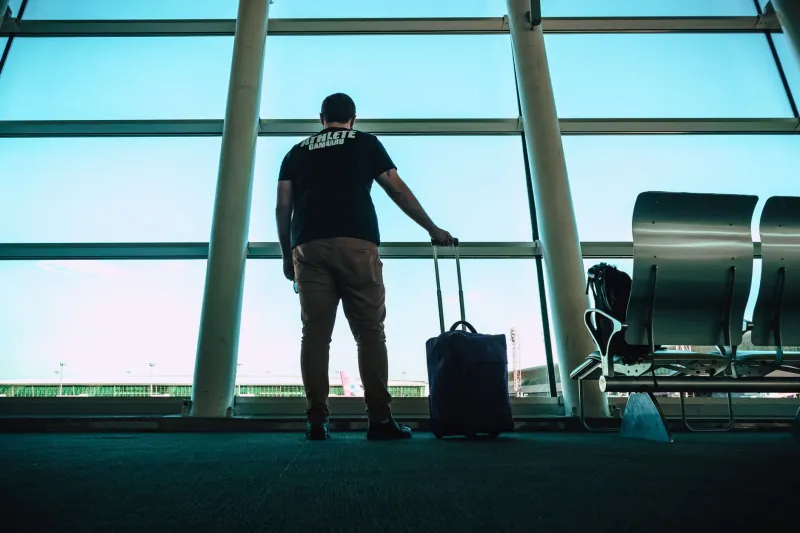
Airports are designed to stimulate attention, and this can amplify anxiety. Find a seat where you can feel your back supported. Look around and identify five objects of a single colour, or listen for three distinct sounds. This is not a distraction from the journey but a way of reminding the body that it is here, in the present, and not in the imagined future.
If it helps, carry a small card with a short phrase that settles you: 'I can take this one step at a time.' Read it slowly. Repeat it once. Then put it away.
Arriving Differently
The festive flight may never become a favourite part of the Christmas journey, and it does not need to. The aim is a more workable relationship with anticipation: less dread in the weeks beforehand, less strain in the departure lounge, and more room to arrive at the other end with something left to give.
If flying anxiety has become a recurring feature of your winters, therapeutic hypnosis may offer a gentle, structured way to begin changing that pattern. At Hypnosis4U, the work is calm, collaborative and paced carefully, one session at a time.